


 25:01
A Freight Insurance Underwriter on What the Supreme Court Ruling Actually Changed
with Brian Dreher


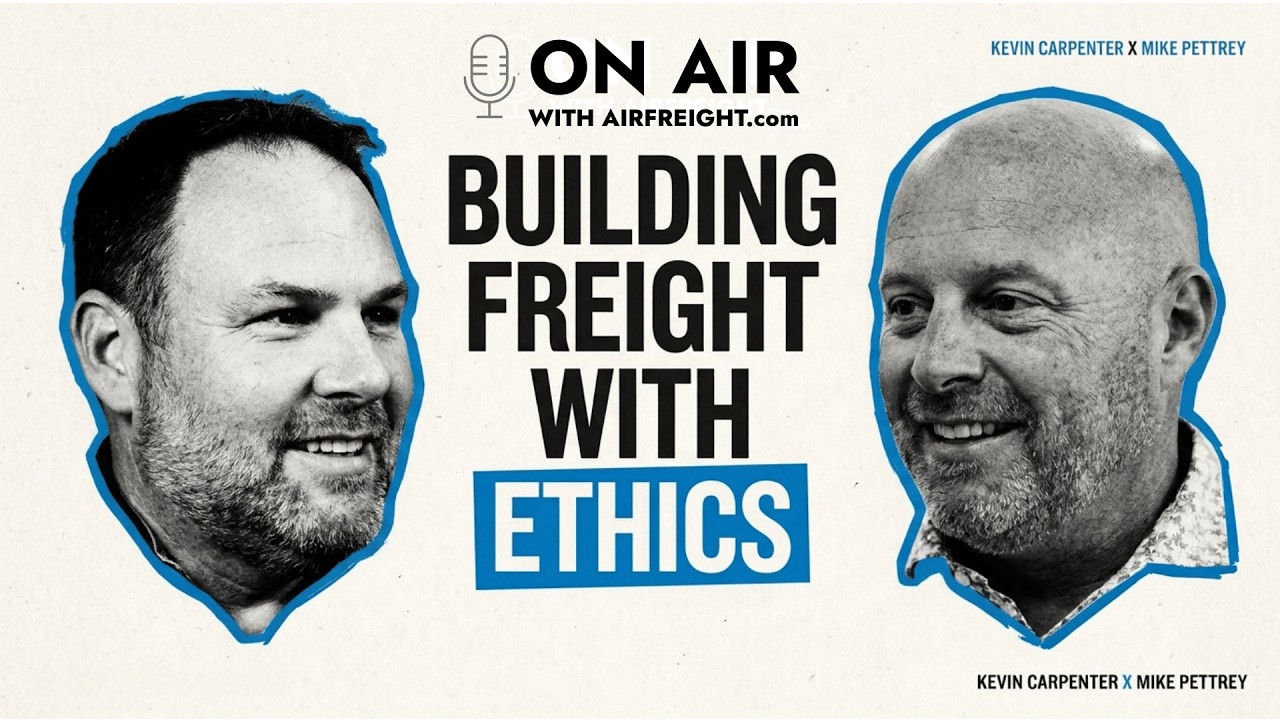
On this episode of On Air with AirFreight.com, host Kevin Carpenter sits down with Mike Pettrey, CEO of C&M Transport out of Painesville, Ohio — one of AirFreight.com's most trusted carrier partners and one of the oldest expedite companies in the country, now in its 35th year.
Mike shares how his father founded C&M around fair treatment of drivers and owner-operators, why straight trucks and sprinter vans became the backbone of the expedite industry, and how dedicated capacity mitigates cargo risk that traditional LTL can't. The conversation covers freight rate compression since 1991, the industry's price-driven race to the bottom, why regulatory crackdowns are (in their view) good for carriers who play it straight, and how technology — real-time tracking, proactive delay alerts — is raising the bar for customer transparency without replacing the human judgment calls that keep freight moving safely.
Kevin Carpenter: Welcome everyone to another edition of On Air with Airfreight.com. I'm the host, Kevin Carpenter. I've been in the expedited freight world for nineteen and a half years. I think it's fair to say this is the most exciting corner of the transportation industry. Stakes are high, timelines are usually short. People in this business have to be able to think quickly, communicate clearly, and our customers rely on us to deliver when failure is not an option. That's why I like to talk to the people in this world, and today will be no different. Today I'm joined by Michael Pettrey, CEO of CNM Transport out of Painesville, Ohio. CNM is another carrier on the very, very short list of our most trusted partners. And I can speak for my colleagues on this one at AirFreight — we love it when CNM's on the job for us. In fact, you guys just picked one up for me this morning out of Louisville for a load going to Auburn Hills. First question, Mike — what's the current status of that load? No, I'm just kidding. Mike, thanks for joining us.
Mike Pettrey: Thanks for having me, Kevin. I appreciate it.
Kevin Carpenter: Yeah, so I want to briefly highlight you guys, because you guys are — like I said, no exaggeration — one of our most trusted partners. If we see you guys as an option and the time frames work, we try to make sure you guys are on it. But take us back to the beginning. How did CNM start? How'd you first get involved? It's a family business, right?
Mike Pettrey: Correct. Yeah. So first of all, thank you for your dedication with CNM and our partnership. It's a longstanding partnership, and it's become more than just a partnership — a friendship. We've gotten to know each other and trust each other, and both companies have always prided ourselves on doing the right thing. And hence why we're both here still today, after being through a pretty rough economic time for transportation over the last four or five years. So again, I appreciate all the trust that you have in us at CNM. And ironically enough, doing this with you — next week will be our thirty-fifth year in business, which you don't hear too often in the transportation world, especially not nowadays. It's kind of the old American story. My dad showed up with a straight truck about thirty-five, thirty-six years ago, and I remember saying, hey, what's this? He said, I don't know, but I'm going to make money with it. So that's how it kind of started.
Kevin Carpenter: So there weren't a lot of straight trucks running in those days.
Mike Pettrey: No. I mean, right now we are one of the oldest expedite companies in the country. Some have been bought and sold and closed. We're one of the last ones, the oldest ones out there.
Kevin Carpenter: Sure. And for our listeners at home, when we talk about straight trucks, we're talking about a twenty to twenty six foot enclosed box truck. They're becoming a little more prevalent out there, but they're the bane of the existence of the big trucks out there. They love to dog on straight truck drivers out there on the road. But it's made for smaller shipments. And that's where expedite is born, right?
Mike Pettrey: Correct. It really started back in the day with the automotive industry, right? Everyone's seen these big automotive facilities — they're the size of cities. So in order to build those vehicles, you also have to have the parts to do so. They try to minimize the warehousing, and that's when they went to lean manufacturing and just in time. So that's what really escalated the whole expedite industry back in the mid 80s, late 90s, is when it really started to take off.
Kevin Carpenter: Yeah, they decided that it would be cheaper to have parts trucked in a certain period of time before they go into production versus warehousing it, right? And that's really, like you just said, where expedite was born.
Mike Pettrey: Yep. And it is a cost savings. It takes a lot of time and effort and money to run a hundred or three hundred, four hundred thousand square foot warehouse that's holding all your materials, when you can just get it right from their vendor, their tier one and tier two suppliers, right to the manufacturing facility.
Kevin Carpenter: Sure. And we've got this great interstate system.
Mike Pettrey: A hundred percent. And since then, the straight trucks and sprinter vans have really turned into more than just expedite. It's more on the dedicated side of things. If you're selling a high end machine or a one-off part to a customer, do you really want it loaded on a truck that has fifty other shipments on it and is going to come on and off that truck anywhere from three to ten different times if it's going across country? So you feel safe knowing that that is a dedicated truck with just your freight on it, and it's being securely hauled across the country or locally. It doesn't matter. It became a very feasible option for other people, and it really mitigated the risk of cargo claims and damage, because it went on a dedicated truck. Obviously there is a cost savings between a full tractor trailer and a sprinter van or a straight truck. So people started utilizing it not just for expedite but also for the dedicated capacity.
Kevin Carpenter: Yeah, it's not always the urgent stuff at this point. It's not always, hey, this is a time definite. It's, we don't want it to be touched at all during transit.
Mike Pettrey: Correct. Yeah.
Kevin Carpenter: Totally one of our selling points as well.
Mike Pettrey: And so back in the day, when we first started, it was your typical true expedite, right? And I'm sure, Kevin, you can speak to this as well — that's a pretty cutthroat industry when you have a lot of people fighting over the same freight, right? So I was dispatching trucks when — well, I'll get my dad in trouble for child labor laws, but I learned how to dispatch...
Kevin Carpenter: I think the statute of limitations has run out. How old were you?
Mike Pettrey: Yeah, that was a long time ago. I was about twelve, thirteen, fourteen years old. But I learned the lingo, and my dad was out there driving. And I won't name names, but my dad started driving for one of the really big companies that are out there today. He was the very first truck actually that that company had. And after about a year of driving and buying four more trucks, so that we had five trucks at the time, they asked him to come in and actually work in operations. They realized my dad was a pretty sharp cat. So he did that for about a year and a half, and there were some things that he didn't like, being on the inside and being able to see things. He didn't think it was fair what they were doing. So I'll never forget the day he came home and said, we're doing this on our own. And here we are. My dad and everybody at CNM — ethics is very important to us. I think about all the ups and downs of this industry. I don't know if there's another industry that has so many ups and downs, other than transportation. But always doing the right thing is why I believe that we're still here 35 years later. I've seen so many companies come and make it really big, but they don't last because they're not always on the up and up when it comes to being very ethical. Some people make it big and sell out and they're living their life, right? But I need to be able to sleep at night.
Kevin Carpenter: So to go back a little real fast — you said when your dad decided that he didn't like, obviously that's a normal story. Someone's within a larger company, they see things being done a certain way, and they just have a different way, a better way. I'm guessing, based on your history and his history, that what he didn't like was the relationship between the carrier and the owner operators and fleet owners, right?
Mike Pettrey: Correct, yeah.
Kevin Carpenter: So that's really interesting, and it really makes sense. It's something I didn't know, that CNM was basically founded on that part of the relationship — the carrier and the owner operators slash fleet owners. And that's proving to be successful. That's proving to be a winning formula. Those are the guys that are actually moving the freight. Those are the guys that are actually making this world happen. And I think what you're alluding to is a lot of times they just get the short end of the stick, and that's where you guys are different.
Mike Pettrey: Correct. And listen, you're only as good as your carrier and you're only as good as your drivers, right? So if you treat your carriers and your drivers as you want to be treated, the end result's going to be positive. And I guess that's what my dad saw internally, that the transparency wasn't there of being fair. So we do pride ourselves, from top to bottom, on always trying to put ourselves in the driver's shoes. And we explain it with transparency to our customers — hey, this is why. If you're sending our truck to the middle of nowhere, we can't just abandon them there. We all know there's several parts of the country where there's not much production. So if you put them there, you've got to at least get them back to some sort of civilization so that they can continue to make money.
Kevin Carpenter: Yeah. I'm guessing that's part of your operations, absolutely looking out for loads for your truck, especially the ones that have ventured outside the primary service area, because sometimes it is the right call to do that.
Mike Pettrey: Yeah, right. And there's plenty of states that you think might be a good area to go. And some customers are like, hey, I need a great deal on this because I've got a load coming back to Cleveland. I think less than 10% of our fleet lives in the state of Ohio. So everything is kind of a headhaul. The drivers just go where the freight is and we find freight for them.
Kevin Carpenter: Yeah, but there's definitely markets that are hotter for freight than others. And that's the main thing we're keeping in mind. How does Cleveland fare in that, from your perspective?
Mike Pettrey: I would say fair to middling. Cleveland — there's a lot of production here. No one's concerned about taking a load to Cleveland. But there's plenty of other places where drivers are like, I've never been there. Am I going to be able to get out? And we take care of them to make sure that they can get out and get back to a higher freight area. And again, you have to do that. And with sharing that with the customers, they completely understand. If they were to put themselves in the driver's shoes for thirty seconds, they would understand, like, I can't go there without having a way out. But in those early days we saw rapid growth. Back then, trucks were at a fair price, fuel was at a fair price, insurance was at a fair price, rates were at a fair price. That was a good time to be in the industry. And we've seen things change over the years. I actually work with lobbyists, and I took some factual data to our Congress and said, hey, look at the costs and rates of 1991 versus now. And you show me another industry where everything has gone up cost wise — trucks, repairs, fuel, insurance have gone up — but the rates are actually less now in 2026 than they were in 1991. So everything that we're doing here today, everything behind you, everything behind me, came where it's at via truck, right? So sometimes transportation is the overlooked object in the room, if you will, because everyone's worried about paying for whatever the item is that they're purchasing and not the shipping.
Kevin Carpenter: Well, and beyond that, it is still a price driven industry. And unfortunately there are obviously sellers in the market that are keeping those prices low. And that's kind of one of the biggest hurdles. That's the reason rates have gone down. So I'm guessing you've probably put some research into what that's from and who those players are.
Mike Pettrey: Yeah, and I think our current administration is doing the same thing as well. There's been some major changes in the last nine to ten months — some major, major changes in the industry, which I personally think are for the better.
Kevin Carpenter: Absolutely. They're for the health of the industry. Otherwise it was on track to — the good companies out there that were just kind of holding on through this, trying to weather it like another storm, probably getting to the end of their ropes. So it couldn't have come soon enough, really.
Mike Pettrey: Yeah. And being the all-American traditional model trucking company in today's world, it was painful to see some of the malicious stuff that was happening in the industry. The reason we have the relationship that we have together, and a couple of other core good people that you and I both use and work back and forth with — we all do the right thing, and it felt like you were getting punished for doing the right thing, because a lot of people weren't. Our goal here is, hey, 35 years. How did we make it 35 years? Because we didn't cut corners, and we pride ourselves on doing the right things. This is a house of cards. You make one wrong move and the liability is unbelievable for the carrier, the broker, and now even the shipper. And again, sharing that information with good customers, they want to mitigate that risk as well. Maybe they can save fifty bucks or a hundred bucks on something, but it's a dangerous game to do so, because the end result could be catastrophic. So we try to mitigate as much of the unwarranted risk that's out there. And I think truly that's why we're here today, because we do do that.
Kevin Carpenter: Yeah. What I can say is, at airfreight.com, we bring a lot of unique shipments to the marketplace as a broker. People find us on Google, and we put a lot of effort into making sure people find us on Google when they're in that time critical freight situation. They get one of us immediately. It's a very premium experience. They get a single point of contact. They get guys like myself who have been in this industry for a long time. And the cool thing is that we understand exactly what you're talking about. We understand these challenges. So what I'll say is we try to do our part with the carrier selection that we use on a load-to-load basis. It's almost like people are waking up to — just take food, for instance. Millions of Americans have awoken to the fact that there's a lot of poison in our food system. And it's the same exact concept as what we have in the transportation industry. It's cutting corners to make more money. And so people want fair trade food now. Not just that — as Americans, we live very comfortably. And again, that's another thing people are waking up to, is how good we actually do have it. So what about that guy that's picking my coffee beans in Colombia? Well, now there are actually measures to make sure that if I buy my coffee and it says fair trade on there, I know that the guy that actually picked these coffee beans at least got something he can live off of to a certain standard, versus a company in the middle that's just paying the absolute bare minimum, slave labor, and then offering it in the marketplace. So as a broker, it's no different for us. We try to be fair trade. We try to be organic. We try to be that healthy option that's the right option for the customer, because we really are taking the necessary steps to make sure something horrible doesn't happen on that shipment. Nobody wants to call in a shipment as a shipper and say, hey, I have an expedited load and it needs to pick up now and needs to deliver at such and such time, and then find out there was a fatal accident. That'll stick with you, I promise. Nobody wants to do that.
Mike Pettrey: A hundred percent. Yep.
Kevin Carpenter: So we're offering a solution that is less likely to do that. Obviously you can never mitigate that completely, but we're taking all the steps that we can take. And we were doing this before this most recent Supreme Court decision.
Mike Pettrey: Exactly. But a core group of us have been. That's why we have this relationship.
Kevin Carpenter: Yes. And that's why that decision was — for a lot of people it was a shock and it was scary, but for companies like airfreight.com and CNM Transport, it was a good thing. It means there's going to be more accountability in the marketplace.
Mike Pettrey: Listen, if we do something wrong or something happens — and listen, things happen. I always say it's not if, it's when. So if you take the proper steps and precautions to make sure that you are mitigating those risks and exposures, the end result's going to be positive. But I kind of felt like we were held to a higher standard while a lot of the other industry was not. And some of the big players are just driven off profit margins — whatever they can do to make money. Well, there's a lot of exposure in that. And listen, I get why people look at a price tag and think, I might be willing to risk this, because there is a little bit of a savings. I have a customer that was a longtime CNM customer and we got beat out by price, and they went to the other side, I call it the dark side, and they had a catastrophic failure that cost them millions and millions and millions of dollars, because they didn't do their due diligence in vetting and they just went for price. And in a court of law, that looks really — you're not going to win. Why did you use them? Because they were cheaper. Well, you know the old saying, you get what you pay for. So now that customer came back and said, listen, we're never leaving you again. We should have never done that. That was painstaking. And unfortunately, the people who expose you to that, they're typically not even in our country. That's what you're seeing with MODIS and some of these new things that the administration's doing. They want to know who is operating and where. You see these articles — there's between six billion and thirty billion dollars of fraud in transportation every year. What other industry has that much fraud? It's unbelievable. So if you kind of stay in your wheelhouse and do the right things, you can really avoid a lot of that. And by us protecting ourselves, we're also protecting our customers. And there is a price tag with that. I always say CNM's not the most expensive. We're not the cheapest. We're kind of right in the middle. What we try to do is be fair and keep the wheels turning, no pun intended.
Kevin Carpenter: Yeah, that's definitely a conversation I've had with my customers over the years — trying to make sure we charge enough. And again, as a broker, I've been doing this a long time. I've definitely been in a situation where I didn't quote high enough to the customer to begin with. And then you're left with, hey, do I use this carrier that I don't quite have ranked as highly? Well, yeah, unfortunately in those situations you do. But again, like you said, you get what you pay for. So we have those difficult conversations with our customers. One of my biggest customers does finished mill work for new commercial construction — for those fun places that are going up across America, like the Top Golfs and the Main Events and stuff like that. And he used me for his expedited stuff, and he used CH Robinson for his truckload stuff, which is the choice of many, many, many shippers across America, because that's going to be one of your lowest cost options out there. Plus it's a name. Nobody's really going to fault you too much for using them. But he just personally had too many failures, too many trucks not showing up when they were supposed to, or just stupid damage here and there because the freight wasn't secured well enough. And again, that's coming from him knowing that he's paying the cheaper price. They're in turn using a cheaper carrier, less experienced. So he finally just handed me that side of it as well. Now he knows he's going to be paying that premium option for his truckload, but he's trying to run a business. He's trying to be a man of his word, and when his materials are supposed to show up, he wants them to show up. So that's a decision that you see happen over and over, and those are our customers, right? Those are your customers too.
Mike Pettrey: Yeah. I think you see with technology today, too, it makes the transparency with our clients even better. Our clients can actually click on a link and see out of the camera, out of the front dash, to prove where the truck is.
Kevin Carpenter: Whoa. What?
Mike Pettrey: Yeah, if we want to send them that link — hey, look. We try to get ahead of anything. So if there's a shipment that, Kevin, you call me for, that's going from A to B and it's a tight window of legal drive time, and the driver gets a half hour into his run and there's a fourteen mile backup, we're telling you now. Instead of tomorrow morning, like, well, the driver's an hour and a half late because he was in a fourteen mile backup — we're going to tell you tonight that this might cause an issue. Because typically with your higher visibility shipments and your expedited shipments, there's people waiting for that. I always say it's like when my wife orders something and I see her standing by the front door waiting for it. That's how it is with these type of shipments. So it's better to let them know early if you've got a crew of people waiting to get this part back to get your line up and running. Time is money. And if people are sitting around for two extra hours because of a traffic jam, you could easily avoid that ever happening. So being transparent...
Kevin Carpenter: Absolutely. And the time that you deliver that update of potential delay — it means so much more when it comes earlier, because it shows that you're proactively monitoring the shipment. That just blows customers away. When you're like, hey, just so you know, we're driving through Utah tonight or Wyoming tonight, there's going to be heavy fog in the area and this is already running tight. So we don't like to drive seventy miles an hour through thick fog. I've tried to do that before — not very fun.
Mike Pettrey: I mean, we've come a long way. Back in the day, we had a cork board and we handwrote every single load and pinned it up there, and we gave the drivers a roll of quarters to stop at a payphone and call us. So it's come a long, long way.
Kevin Carpenter: Sure. Well, that spirit lives on. That is expedite. That is the expedite industry. And that's what makes it a different animal from the rest of it — from full truckload, from normal logistics. But now what we're doing, what's very exciting, is that we are leveraging technology a lot more, exponentially more at this point, to where we can deliver those updates. Now the examples we just gave of someone looking ahead, forecasting, hey, this is already running tight — up to this point, you need that human element, especially someone with experience to be able to look at that and tell. But I think we are getting to where technology is going to take a lot of this stuff. It'll never be taken out of our hands. I feel like it's going to be a long time before they can fully automate this industry. I think we're safe for a while. And in fact, that's one of the things that's going to separate us again — as everything else progresses into, hey, you call and you're going to get the top of the line AI agent. Well, hey, you call airfreight.com, you're going to get a human. And we're going to pick up right away.
Mike Pettrey: And I can tell — listen, you get all these soliciting calls trying to put AI into your system. I can tell every time whether it's a real person or not. And I'm the guy that when you call and they're like, "reach the—", I'm hitting zero. I want to talk to a human.
Kevin Carpenter: Yeah. But man, they're getting better.
Mike Pettrey: I mean, if you call CNM right now, a human's going to answer the phone. We don't have any automated — I don't care how long we've been around and how big we get, a human is always going to answer that phone.
Kevin Carpenter: You heard it here. All right, cool. I don't ever want to hear a robot now, Michael.
Mike Pettrey: No, you will not.
Kevin Carpenter: Cool, man. Well, this was great. Before I let you go, you have to run through the On Air Gauntlet. It's a little thing that we made up for this show. It's just going to be three rapid fire questions that you shouldn't have to think about too much. Just give me the top answer that comes.
Mike Pettrey: Okay.
Kevin Carpenter: All right. Here we go. On Air Gauntlet with Mike Pettrey. Question number one: what's your top vacation destination?
Mike Pettrey: I would say Southwest Florida, particularly Key West. I'm a big boater and that's a great boating community.
Kevin Carpenter: Beautiful water down there. Best Browns quarterback of all time.
Mike Pettrey: Oh boy. Is there one? I have to go with Bernie Kosar, because that's who I remember.
Kevin Carpenter: That's the correct answer. And then last question, Mike — what do you want to be remembered for?
Mike Pettrey: The legacy of CNM and what we've done and the services that we've provided, and the honesty — it stems through all of our employees. CNM wouldn't be what it is today without our employees. I think that we have some of the best people that you could ever imagine. I travel all around and that is the first thing people say: man, how did you find the people that you have? And well, I pay for what they do and I picked out the best. They are a great group of people and I pride myself on seeing them be successful.
Kevin Carpenter: I totally agree with you there. I think northeast Ohio produces good people as well.
Mike Pettrey: I agree. Just not quarterbacks.
Kevin Carpenter: Fair enough. Awesome, Mike. Thank you very much for being on air with airfreight.com.
Mike Pettrey: Thanks, Kevin. I appreciate you.
25:01
 22:03
 24:15
 20:19
 20:26
 31:04
 26:48
 24:30
 24:42
Whether you need a dedicated truck, flatbed, van, reefer, or a team, AirFreight.com’s expedited truckload services have you covered.
Our hot shot trucking services are ideal for large cargo that may have unconventional weight, dimensions, or packaging.
Emergencies happen. Standard deliveries can go wrong. To ensure your time-critical freight reaches its destination, AirFreight.com offers same-day delivery services.

talk to an expeditor now
 Call (800) 713-1000
Follow Us