


 25:01
A Freight Insurance Underwriter on What the Supreme Court Ruling Actually Changed
with Brian Dreher



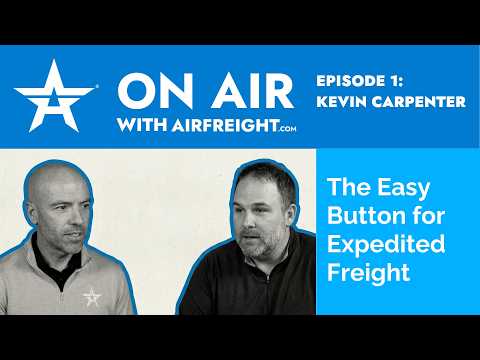
In this episode of On Air with Airfreight.com, host Kevin Carpenter sits down with John Elliott, founder and executive chairman of Load One, to talk about building one of the country’s leading expedited freight carriers and what it takes to stay competitive in a fast-changing industry.
John walks through his unusual path into trucking, starting with a family legacy in transportation, a college degree in aviation management, and an early career that eventually brought him back to freight. He shares how Load One began as a regional truckload carrier before a series of decisions — including one persistent employee bringing him an expedite opportunity — pushed the company into the expedited freight space.
Kevin Carpenter: Ladies and gentlemen, welcome back to On Air with Airfreight.com. This is a podcast about expedited freight. I'm your host, Kevin Carpenter. I'm very excited about today's episode, and that's because today's guest is someone who has not merely participated in the expedited freight world for the last couple decades — he has helped shape it. John Elliott is the founder and executive chairman of Load One out of Taylor, Michigan. Widely regarded as one of the top expedited freight carriers in the country, certainly on the very, very short list of most trusted partners of airfreight.com. John is former vice president of the American Trucking Associations and former chairman of the Truckload Carriers Association. I've got to say, I didn't think we'd land a guest of this caliber this early on in our run, but nonetheless, thank you very much for doing this, John. Thanks for taking a chance on us.
John Elliott: No problem. Thanks for the invite.
Kevin Carpenter: So I don't think the general internet has seen you for a little bit now, John. What are you doing these days? Catch us up.
John Elliott: You know, I migrated from CEO of Load One to executive chairman and chairman of the board. Now it's been about two, two and a half years. So I am, I'll say, partially retired. I migrated from the wonderful climate of Detroit, Michigan — I live down in Cancun, Mexico primarily now. I go back and forth a decent amount, but this is my primary home. Still very involved with Load One, on the board and with an ownership stake, and I also have some financial investments in other transportation companies and other industries as well. So I kind of dabble around to keep myself busy and pay the bills.
Kevin Carpenter: I read that you are a third generation transportation professional. Can you tell me a little about what your grandpa and your dad did?
John Elliott: Yeah. My grandfather was really the American dream story. Grew up relatively low income, in Pittsburgh — right outside Pittsburgh, Pennsylvania. Worked in the coal mines. He came out of the coal mines and went to work driving truck. Did that for a while, became an owner operator, bought his first truck. Went from there — had trucking companies, construction companies, a couple different things, then settled in trucking again.
Kevin Carpenter: Would that have been in like the sixties?
John Elliott: Yeah, that would have been probably in the 70s. He built a good size motor carrier. It's still running international, does a lot of automotive business in and out of Mexico. It's still in our family, somewhere in the area between the companies of six, seven, eight hundred trucks. I worked for my grandfather right out of college. Ironically, I have a degree in aviation management. When I grew up — I grew up in trucking, my first job was, here's a broom, sweep out trailers. Worked through dispatch and maintenance and did those things. Went to college and said, I want to get the hell out of trucking. Got a degree in aviation management. I thought doing air freight or air cargo would be much cooler. Back then it was like Flying Tigers and DHL and some of those companies. Ironically, my grandfather had started an aviation division in his company, so I had worked there right out of college. Did it for about two, two and a half years and realized that honestly working for my family was not my destiny. My grandfather was a very smart man, but he also believed that until you're forty years old, shut up, you don't talk or know anything. And I wasn't prepared to wait 20 years till I could speak. So I got an offer from a trucking company that honestly was a very good offer. I told them, turned it down once or twice, and then they started talking about numbers, and I'm like, well, I'm back in trucking. Went to work there as operations manager and director of operations and VP of operations. During that time I said, hey, do you guys care if I buy a truck? And they're like, no, no. You want to buy a truck? I'm like, yeah, I'll put it on a different carrier, that way it's not a conflict of interest. And I went out — I was twenty three years old, I think, at that point — I rented my first semi truck, believe it or not. Did okay, said hey, do you guys care if I rent a second one? They're like, no, no, it's fine. Got a second one, got a third one, got a fourth one. Started slowly buying trucks. Finally I had thirty-two trucks on the side when I said, it's time to quit your day job and focus on your side job of thirty-two trucks. So I did that. Was an agent for a motor carrier, was a brokerage agent, did that for a number of years. Then 2008 hit, the recession, things like that. Actually 9/11 was really the big catalyst, I should say, not 2008. And I realized, you know what, when the world gets a little wacky or out of control, I needed to be in full control, not an agent. And so I made the decision to downsize. Actually, as a fleet owner, I had almost 150 trucks, which was pretty much unheard of, nowadays especially. So I downsized and said I was going to become a full motor carrier. Made that move in 2003 and founded Load One. We were originally a regional truckload carrier. Being regional, back then it was the freight nobody wanted. Everyone wanted to go to Laredo, California, places like that. Nobody wanted to haul Detroit to Dayton, Ohio, Detroit to Chicago, Detroit to Cleveland, those kind of things. I looked at that as low hanging fruit. The rates were better, less competitive. But you had to be very efficient.
Kevin Carpenter: Yeah, that's interesting.
John Elliott: Yeah, you had to be very efficient on planning of the trucks. You had to get them out and back in one day. So the time critical factor kind of indirectly became an element for us. And then it was kind of funny — when I started my own company, the first person that came to work for me, a young lady, she was great. But when I hired my second and third person, she didn't coexist very well at first. She believed, like, well, I'm here first, I'm the boss. I'm like, no, no, you're not the boss. You were just here first. And after a little while, it got rather frustrating and tense with her and the other women in the office, and she made the decision to leave. About a month or two later, she called me and said, hey, I messed up. I made a stupid decision. I really want to come back. And I said, Jenny, I'd love to have you back. But you've got to play in the sandbox nice. And she did. And what's ironic is she had gone to a little expedite company, like 10, 12 trucks. So when she came back, it was probably two weeks, and she knocks on my door and she's like, John...
Kevin Carpenter: And so Load One at this point was still just a regional truckload carrier, basically.
John Elliott: I'd love to tell you I had an epiphany and saw the future of expedite and the whole industry. That would be a lie. Maybe in the movie or my book, I'll say that, but in real life, no. Jenny came to my door one day and she knocked and said, John, I've got this guy, he was a fleet owner over at this other company. He had one straight truck and one cargo van. She goes, they're messing around with his paperwork and his pay, and he's a really nice guy. Can we bring the trucks on here? And I'm like, no, no, Jenny, we do 53 foot dry vans. I have absolutely no idea what I would do with a Ford Econoline van. I said no, no, no. Next week, here she was again at my door. Like, no, no, Jenny. Probably after four or five weeks, finally I'm like, fine, fine. If it doesn't work, we're getting rid of it. And lo and behold, today I think we're the third largest expedite company in the United States. So I would love to say it was my wisdom. I basically got tired of listening to her. And she's just great. I love her. She stayed with us all the way till she retired. So it was a funny story that changed the paradigm of our trajectory.
Kevin Carpenter: Well, what's interesting about what I just heard you say about staying fairly regional and taking that low-hanging fruit that the other carriers don't want — that has echoes in today's expedite industry. I've worked with multiple expedite carriers and that's called the primary service area. A lot of expedited carriers in general will kind of focus on staying in the primary service area, which would be Michigan, Ohio, Indiana, Kentucky. Maybe a little PA. But going further...
John Elliott: Yeah, the Midwest and the southeast there, the Carolinas.
Kevin Carpenter: South of Tennessee, going further west than Illinois — they want a premium for that now. Well, again, or you'll have carriers that want those miles. So it goes both ways. But it's just interesting to hear you talk about doing that regional stuff. And that kind of shaped the industry in and of itself, because that's where a lot of the plants are too, right?
John Elliott: Yeah. Well, I think part of the challenge — and we went through it when we were smaller too — a small expedite company has maybe the owner doing the sales, or maybe one salesperson, maybe two. So if I send that truck to Texas, we don't have any salespeople there. So I'm reliant upon bid boards or brokers or people that are not essentially the route you want to do. So you tend to stay.
Kevin Carpenter: Sure. Yeah, and in the hierarchy of the type of business you're bringing in, of your customers, obviously direct shippers are the premium, right?
John Elliott: Yes, exactly. And Load One was at one time, I'll call it, a carrier's carrier. A lot of the work we did was for other carriers. Because okay, that guy in Tennessee, he's got salespeople, he's got freight, I don't. Over the years we grew where we built pretty much a nationwide footprint of sales. So our trucks will go further. We want to cover the whole country. But again, even in our fleet, a lot of them like to stay in that five, six hundred mile radius of Detroit or the Midwest, because of the plants. And you would think being Detroit based, automotive would be our primary, but believe it or not, it's not our largest vertical. We do a lot of automotive, don't get me wrong, but it's not actually our number one vertical.
Kevin Carpenter: What would you say is your number one vertical these days?
John Elliott: For us it's heavy truck, believe it or not.
Kevin Carpenter: Okay. Interesting. Aside from making that decision to go expedite, to explore that side of the trucking business, what would you say is the key decision — either business wise or a key cultural pillar — that helped determine Load One's long term success?
John Elliott: Early on, I think it was me not losing touch as the company grew. I was a little bit of an anomaly. I would still go to the truck shows, I'd still work the booths, talk to people firsthand. I'd go on a lot of customer sales calls, even when people were like, the CEO's coming. I genuinely enjoyed it. One of the things I always would do — our headquarters in Taylor is two large buildings. The maintenance and driver facilities are in one building; the warehouse, all the offices and administration is in another building, because we outgrew the first one. And I would walk between the buildings, and you have to walk the whole length of the parking lot with all the trucks. So I would walk and stop and talk to drivers, look at equipment. And it's funny — years later when I wasn't there full time and started working remote and started to phase into my next phase, the amount of drivers on Facebook and things that would talk about the days of John walking the yard, that I didn't realize had the effect they did. It's keeping a level head and keeping with your people and not just sitting in an office all day — getting out of your office. That's one. And two, I think the other best decision I made was we invested very heavily early on in technology. It was just always part of our DNA. Things like — we were one of Qualcomm's first customers to have in-cab scanning, which was unheard of, that we could deliver, scan a POD in and get it into our system and to a customer. Things like that. About 10 years ago in our industry, ninety, probably ninety-eight percent of the carriers are on two different software platforms, I'm sure you're familiar with. We chose to go the route to build our own, which was a very expensive move. The bank and people thought I was a little crazy to go that route. Today it's without a doubt a cornerstone of our company. The technology we have built is second to none. And I look at the things we're doing now with AI. People all love to talk about it, but if you don't own the software and you don't own the databases, you're very limited on what you can do.
Kevin Carpenter: Yeah. You're just waiting for your TMS to offer it, otherwise.
John Elliott: Yes. And by the time they offer it, you and all your competition get it at the same time. So the things we're doing, I think we're years and years ahead of that.
Kevin Carpenter: I think you are too.
John Elliott: For us, it's not only a great competitive advantage, but it's also for our staff — our response times, our ability, our billing. We put it across so many thresholds of the company. And we're in phase one of, I'll say, four phases or five phases of this. It's incredible the things we've seen and done already.
Kevin Carpenter: Yeah. I'm sure that keeps evolving. Your phases are evolving as technology is now changing more rapidly by the day with AI.
John Elliott: Yeah. Even if I go back two years before AI, it was the things that we didn't realize. We're not computer programmers. So the tech guys would be like, well, why didn't you ask for that? We're like, well, I had no idea that would be even imaginably possible. So why would I ask? Let alone somebody who's sitting at a desk doing billing. They don't do anything with that. They would have no way to fathom what is possible. So it's very exciting. A lot of people are scared of it. Even some of our people are like, I'm going to lose my job because this is automated. It's reading emails, it's generating this, it's doing quotes. And I think no, it'll allow us to grow and expand and handle more business.
Kevin Carpenter: And do it better.
John Elliott: Without a doubt. The error rates are less, the human error. A lot of the work that I'll call the dummy work of data entry and things like that — people make simple mistakes when you're entering 50 orders a day, that you invert a time or a date. Things that you're not challenging a person with, you're not making their job interesting by doing that. And I go back to, the sky was falling when we put satellites in the trucks. Because it used to be drivers stopped, they went to the payphone: hey, I'm making my check call, I'm here, I've arrived. Somebody would go in the system, update it. Okay, still waiting to unload. This, that. Well, when you took all that away — like I told people, nobody lost their job. You just went from doing dummy data entry work to now you could do this, or we could have five, ten more trucks under you and the workload's less than you could do with having 20 before. So it really lets you leverage and scale the economy more so than replace people's jobs. So I think it'll change the evolution of people's jobs. But I'm excited, because while it automates a lot of the functions, on the other hand it frees people up to have more interactive relations with the customers.
Kevin Carpenter: Right. It gets you more to the crux of what you're doing here — not the order entry, not the busy work that's all prone to error.
John Elliott: Yes. Track and trace and all those things, without a doubt. Nobody gets in this industry and goes, wow, I want to do track and trace. But it's a necessary evil.
Kevin Carpenter: Yeah. And when you're going down the path of considering what technologies to adopt early on — obviously trucking is communication, it's communicating as efficiently and thoroughly as possible. And one cool thing is communicating with all your drivers at once, right? But as you're going down the road of determining that technology that you're going to adopt, what was the criteria? Is that what you were trying to do — lower the workload on dispatch, lower the workload on order entry and stuff? Is that what the initial goal was?
John Elliott: Yeah, to some extent. We did a lot of in-cab technology to improve the driver experience. We were very early on with in-cab navigation, very early before everybody had Waze. And like I said, in-cab scanning — we were the first customer for Qualcomm to go live with that product.
Kevin Carpenter: Which takes the load off of not just your driver and dispatch, but also your accounting. That ripples all the way through the company.
John Elliott: Yeah, it's a win-win across the board. And we wanted to leverage technology in a number of ways. We wanted to improve the driver experience, one. Back then everybody was basically on one software platform. Everyone had trucks. So what you were competing on was rates and service. Rates — some people can go below market and not be very intelligent about their rates because they don't understand their costing. But in general the rates average out. Service — ideally everyone's going to offer a pretty good product as far as service. So how do you differentiate yourself? For us, differentiating was that we applied technologies that our competition didn't have.
Kevin Carpenter: Yeah, that makes sense. Going back to the early days, what was the shipment, customer or mistake that taught you how high stakes this business is, and unforgiving even?
John Elliott: You put me on the spot with that one. There are moments where drivers do sometimes the most amazing things — and I use amazing as a nice word.
Kevin Carpenter: It goes both ways for sure.
John Elliott: Yeah. Things that have created situations at customers. You've had situations with accidents that take plants down. And situations where you learn the hard way about insurance and rules. For instance — the first time we learned the hard way, a customer called, it was like a five hundred thousand dollar cargo load. And I think at that time we only carried a hundred thousand. Now we carry much higher. But we said, okay, hey, we have to go out and get a quote for the extra 400 and charge you. They said, no, no. We insure that ourselves so you don't have to. Okay, we're like, put that in an email to us. Boom. So they did. Okay. Lo and behold, of course, the truck gets in a terrible accident. It wasn't our fault. We pay our part of the insurance, they pay. Six months later, their insurance company comes back and sues us for subrogation. And we're like, well, no, you said — and they're like, you said you were insuring it. And we're like, well, yeah, we did insure it, but apparently we can't stop our insurance company from going back to you to try to reclaim their money. That's when you learn you have to have them waive subrogation, and their insurance company has to as well. A very expensive lesson, when here we thought we did everything right and all of a sudden you're on the hook.
Kevin Carpenter: So the solution to that particular issue is what — better language in the rate confirmation?
John Elliott: Yeah. You want to make sure — well, ideally you want their insurance company to put in writing that they will not subrogate. But honestly, as a company, we don't even accept that anymore. We're like, nope. We will get the extra insurance. If you don't want to do it, that's up to you.
Kevin Carpenter: You're not trusting them.
John Elliott: Yeah, we're not going to take a chance to go down that road again. So that's probably a good example. There are lots of lessons you learn in different ways, but they're all different. We could make probably a whole series out of those.
Kevin Carpenter: All right. You built this company from the ground up. How hard was it to hand the CEO seat to someone else?
John Elliott: You know what, I didn't build it by myself. I built it with a really good team. I was very blessed. If I had to look at what was my skill set, it wasn't my charm and wit. I think my best luck was I had a good knack for people, and reading people and understanding people and getting the right people. And like I said, I was really blessed over the years — the management team that we had, our drivers, our staff, everybody. Nothing's perfect, but my team was definitely good. When I look at today, Chad Tabor sits in the president's chair, or my old chair. It's kind of weird to go back when I'm in the office, to visit my old office. Now I sit in the conference room when I'm there, because I don't have an office.
Kevin Carpenter: How often are you back?
John Elliott: Lately, not as much. I had a little surgery, so I couldn't fly for a while. But generally I try to appear every sixty days or so. I'll make an appearance. You want to be there to support your people. And I talk to most of them — the executives, every week, some of them every day. Our president probably almost daily. It could be a simple question or simple thing, or hey, how are we doing today? But part of the challenge of letting go is you have to detach enough that people say, this is the chain of command now. I can't go around, I can't go to John. That's not the route any longer. So you have to balance that.
Kevin Carpenter: Yeah. But for you to get to that point where you're ready to actually hand that down — what did Chad have to know? What did he have to understand about Load One before you trusted him with it?
John Elliott: He came up on the sales side of the company. So his last position was VP of sales and then chief revenue officer of the company. Then what we did was, I acted as a co-president with him for a period of time — not officially or not publicly. He knew what we were doing, as I transitioned more things over to him. And then when the time came that we made the announcement, everybody was like, we could have seen that coming. That makes sense. I think it was a better transition for him. That way people weren't like, suddenly he got the job all of a sudden. He relocated up to Detroit, because before he had lived in North Carolina. So he got to be hands-on with everybody, got to be involved in a lot of things. I let him do more of the operational things more and more as CRO. I did a lot of the, I'll say, grunt work on the administrative side — the non sexy side of a business that has to happen and be managed, when you look at everything from cash flows to insurance and different things like that. They become cumbersome. And then we transitioned as I moved to executive chairman full time.
Kevin Carpenter: Yeah, that's awesome. You're still kind of steering the boat.
John Elliott: For us it was a very smooth transition, because he was one of my right hand guys anyway, and I didn't sail off into the sunset. I mean, I let him steer.
Kevin Carpenter: Navigate maybe. Maybe help navigate a little bit.
John Elliott: Yeah, I help navigate, or kind of go, mm, good idea, good idea. I'm basically a good sounding board.
Kevin Carpenter: Yeah, but you're also an excellent resource. And I would be remiss right now, while I have you, not to ask what you see as the current state of trucking. You got a whole episode on some of the top podcasts in the world. I think Tucker Carlson just had one where the whole podcast was a guy from the trucking industry on just talking about the general state. So it's obviously right here in the forefront. What's your take on things right now in general?
John Elliott: I mean, we came off of a historic low. We saw basically a three and a half year freight recession. We had never seen that. In my life, the longest one was eight months long. So this one was one like no other. It's good and bad. I think it made good companies stronger in the end, or will make them stronger in the end, because you really got down to looking at every penny, understanding your systems, analyzing your data more than when things are good. Unfortunately, we saw after COVID — when things were good, any Joe Blow could go get a truck and make money, and didn't understand their rates, didn't understand their costs, didn't care what they financed it for, didn't care what they paid, because hey, when things are through the roof, you can afford anything. Well, those things don't last. So unfortunately a lot of COVID money went in, government money went in. They kept a lot of those guys in business far longer than they should have been. And some of the big banks and finance companies that are big in the trucking industry, I think kept companies in business because their portfolios were exceptionally hard hit. They didn't want to take the hit that they needed to take for their lenders. So I think they were like, hey, pay interest, pay anything, and we'll try to keep this going as long as we can. You just saw BMO exit — they were one of the biggest. And I think they carried a lot of companies that I question should have been in business.
Kevin Carpenter: Right. And trucking is so cyclical — that's the cycle that kind of dictates trucking overall. Companies come and go.
John Elliott: Yeah, it was just a very extended cycle. And when it turned, there were some other things — you had the English language proficiency test, you have the chameleon carrier crackdown. A lot of things that all needed to happen and should have happened. They're all happening at one time. And as well, I think you're still going to see more capacity leave the market. Unfortunately, Kevin, a lot of people don't understand — small carriers especially. Any business is about the numbers. And I've seen just as many companies go out of business during upswings as downswings, because suddenly they think they're doing great. They grab more business, they're charging more. It's great. Well, also you can't cash flow. When things go good, it eats up cash.
Kevin Carpenter: Little things you've got to think about when expanding, right?
John Elliott: When you suddenly say, wow, the market's up, I'm getting 10% more on my rates, I'm able to bill 10% more, I'm able to get 10% more business — wait a minute, both those 10%s are going to suck up how much cash? You were running super tight going into it, barely trying to survive. Now it turns and you don't have 20, 25% more cash to sit on for 60, 90 days till you get paid. So I think you will still see yet another round of carrier failures come here in the next three to six, nine months, over carriers that couldn't manage the upswing and didn't have the financial resources. If you're already factoring, you don't have twenty, thirty percent more available to you. You don't have assets. So that's one nice thing about us being a blended asset company. We have a lot more financial stability, and we have a private equity partner. So we have a lot of things we're able to bring to the table.
Kevin Carpenter: Yeah, that's nice. But for all the shippers listening, you heard it here first. Rates are probably going to keep going up, guys.
John Elliott: Yeah, I would say definitely. If you look at the last three, four years, nobody got a rate increase. General inflation at three or four percent a year has to be compensated for. But the price of fuel, the price of trucks, the price of insurance, labor — all those things have gone up significantly. And unfortunately shippers are going to think it's payback time for carriers. No. We just need to recoup.
Kevin Carpenter: No. Just market conditions, you know?
John Elliott: Yeah, we need to recoup what was left on the table the last three, four years, to get back from a situation where we were running at rates that weren't sustainable. You couldn't afford to replace equipment. At some point the debt comes due. You have to replace the trailers. You have to replace the trucks. So guess what? You're going to pay today's rates on what a new truck costs. You're not going to get the truck for what it cost six years ago. It's forty percent more expensive today. And your rates aren't forty percent higher. So do the math. It has to come from somewhere.
Kevin Carpenter: Yeah. The question is — and I don't even know if we want to go down this road — but what about when the customers can't pay that? What if they simply don't have it in the budget? That's where things get scary. We're not going to solve that on On Air with airfreight.com today.
John Elliott: That's a macroeconomic problem. No different than us in our industry. At some point, if people can't operate at certain rates, the herd thins itself. Unfortunately they have to go back to their customers, and it's a chain, but it is what it is. The price of jet fuel goes up, guess what? Your airline rate goes up. The price of everything went up. For trucking, our rates have to equalize out. Nobody's running a trucking company as a charity, or you can only lose money for so long until the bank says, hey, you're done.
Kevin Carpenter: Yeah. And we talk about the importance of trucking. Most Americans don't appreciate the fact that everything in the room that they're in right now was brought on a truck. So when you have something this profound that's happening in trucking, it only makes sense that it's going to affect everything.
John Elliott: Yeah, there's no question. It's going to have a ripple effect across the whole economy. It's a major input when you look at the macroeconomic or microeconomic numbers of manufacturing and food and all those things. Trucking's tied into pretty much everything.
Kevin Carpenter: Yep, that's right. Well, John, thank you for coming on. Before we wrap up, we put all of our guests through what I like to call the On Air Gauntlet.
John Elliott: Okay, well, again, you did not warn me about this one either.
Kevin Carpenter: This is going to be three rapid fire questions. Just give me the first answer that comes to your mind. In a movie about your life, which actor plays John Elliott?
John Elliott: I'd like to have Russell Crowe, but more in the Gladiator phase than the fat phase.
Kevin Carpenter: Not in the current beer belly phase.
John Elliott: Not now when he enjoys beer and smoked meats. More in the old days.
Kevin Carpenter: All right, question one B. Who plays Dan Boaz, airfreight.com founder?
John Elliott: Tom Hanks. Just because that guy can play anybody.
Kevin Carpenter: What's your favorite Mexican dish?
John Elliott: You've got to love street tacos. You've got to love genuine street tacos, hands down.
Kevin Carpenter: And last thing here — aside from your professional accomplishments, what do you want to be remembered for?
John Elliott: I guess being a good father, and some of the things I've done for charities, and maybe like I said, being chairman of TCA and things like that, where you tried — those are non paid positions where you help to shape the industry or guide the industry and advocate on behalf of the industry. It's one thing to make money in an industry and do well on that side, but it's another thing to give back and try to help improve the industry for everyone involved for the long term.
Kevin Carpenter: And as a guy that's been in the industry for twenty years now, I thank you for what you've done to contribute. And I thank you, John, for being on air with airfreight.com.
John Elliott: Thanks for having me, Kevin.
25:01
 22:03
 24:15
 27:18
 20:19
 20:26
 26:48
 24:30
 24:42
Whether you need a dedicated truck, flatbed, van, reefer, or a team, AirFreight.com’s expedited truckload services have you covered.
Our hot shot trucking services are ideal for large cargo that may have unconventional weight, dimensions, or packaging.
Emergencies happen. Standard deliveries can go wrong. To ensure your time-critical freight reaches its destination, AirFreight.com offers same-day delivery services.

talk to an expeditor now
 Call (800) 713-1000
Follow Us