


 25:01
A Freight Insurance Underwriter on What the Supreme Court Ruling Actually Changed
with Brian Dreher



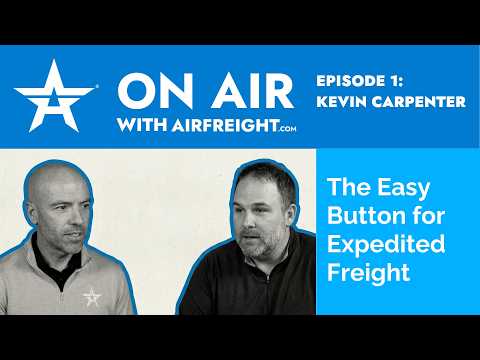
Unlock the complexities behind urgent logistics and how expert providers like airfreight.com support industries that can't afford delays. This episode features real-world examples from Mauser Packaging Solutions and deep dives into the critical decisions that keep production lines moving smoothly.
Kevin Carpenter: I'm Kevin Carpenter and this is On Air with Airfreight.com. It's a podcast about the high-stakes world of expedited shipping. Today we're going to highlight a real business that keeps the world turning. We're going to talk to real professionals within that business, and we'll look at the very real challenges they face when things don't go as planned and the clock is ticking. Today I'm joined by Kim Hardwick, Transportation Manager; Brad Beck, Production Manager; and Dan Palmer, Plant Manager for Mauser Packaging Solutions, a company that manufactures industrial packaging used across a wide range of industries. And I won't give away anything else, because the first question I have is for Brad. Brad, if you don't mind giving us a high level about what Mauser does, and in particular your plant there in Mason, Ohio.
Brad Beck: Mauser Mason — we are in the packaging business. We do steel drums here. We have one plant that is 100% 55 gallon drums, and then we have another plant that does all of our intermediate specialty drums. So anything from a 10 gallon drum to a 35 gallon drum, from 14 inch, 16 inch, 18 inch diameter on the intermediate side.
Kevin Carpenter: Okay, and both those plants are in the Mason, Ohio area. So it's kind of like a double plant situation over there. Because I think Mauser has what, over 150 or 160 locations? Is that what I saw? And that's two of them right there in Mason, Ohio.
Brad Beck: Yep. Yes, and they're both metal facilities here at Mason. They're actually across the street from each other.
Kevin Carpenter: Got it. So among all the logistics challenges you guys have, that's probably not one of them — getting stuff in between those two plants. I would hope not.
Brad Beck: No. No. Really, we're fine there.
Kevin Carpenter: And then another question just to follow up on that. Do you know what industries you guys serve?
Brad Beck: We serve industrial, medical, and food grade. Those are the main ones.
Kevin Carpenter: Okay, so plenty of chemicals are going in these things, as well as food ingredients, stuff like that. Awesome. All right. Next question I have is for Kim. Kim, could you give us an idea of what your shipping plate looks like? Do you handle both those plants, first of all?
Kim Hardwick: Yes. Give me a little more idea of what you're looking for.
Kevin Carpenter: Sure, sure. Are you guys moving freight in every single day and freight out every single day?
Kim Hardwick: Not so much freight in, as it would be parts and supplies to do the production, but freight out every day, Monday through Friday.
Kevin Carpenter: Okay. And what's the normal method that you're sending freight out? And obviously when you're sending freight out, that's delivered goods.
Kim Hardwick: We do have contracted carriers that we work with, and we use them for all of our outbound shipments that are truckload. When it's less than truckload, you may hear from us — and everybody else that does LTL.
Kevin Carpenter: Got it. Okay, and so these contracts are kind of built into probably the contracts you guys have with the customer. The customer already has that built in, as far as like, I know when I place an order, I'm going to have it within a certain period of time from the time that order was placed. All right, just out of curiosity, are there ever situations where customers need something faster than normal?
Kim Hardwick: Oh yes, every day.
Kevin Carpenter: Okay, and how do you have to handle that?
Kim Hardwick: Well, when it does come down to it having to be there next day, if it's something not too far away and one of our carriers that are contracted with us can handle it, we'll use them. When it gets a little too far away to get it to where it needs to be in a timely manner, we'll reach out to you.
Kevin Carpenter: Okay. And so when — let's say a customer calls, and obviously you must already have some kind of finished product that's ready to go out at a given time. This is a side question: how often do people ask for stuff that you don't have produced yet?
Kim Hardwick: It probably happened about five minutes before this meeting, and Dan let production know they can pull one in tonight so we can get it to the customer tomorrow.
Kevin Carpenter: Wow, okay. So that's pretty cool. And full disclosure to everyone — all our customers listening, or I mean all the listeners to this podcast, the many tens of thousands of people that are going to listen to this — I'm your single point of contact for whenever you guys have an expedited need, or something that isn't able to be fulfilled by your normal carriers, by your contracted carriers.
Kim Hardwick: Correct. It does happen, though.
Kevin Carpenter: Now one more question for you, Kim, if that's all right. Whenever somebody — if you get an order in late in the day and they're like, hey, I need this tomorrow — I'm guessing there's a fair amount of the time where your contracted carriers are not able to get in there today, right? So that'd be another situation where expedite comes up.
Kim Hardwick: Normally that's not the way our system should run. We do have a lead time. But there are those occasions, like I just said, the one that called in today needing help. So yes, it is a matter of, if our contracted carriers can't do it, we have no option but to call expedited.
Kevin Carpenter: Okay. Okay, I lied. I actually have more questions for you, Kim. We all know — well, we don't all know — LTL shipping. That's the most common type of shipping used all across America. And that's where you have route trucks that come in and make a pickup, and they make multiple pickups from multiple companies. And then that route truck goes to a terminal, that freight gets sorted onto another truck that's going toward where it needs to go, and then it gets sorted again. Going from here to Chicago, for instance — how many times do you think that's going to get transferred?
Kim Hardwick: Probably at least three, if not more.
Kevin Carpenter: Three times. And that's three different times that workers need to be paying attention, forklift operators need to be not crushing things and slamming things into each other. And also that that stuff makes it on the right truck. Three different — all sorts of margin for failure there. Talk a little bit about the peace of mind whenever you call me, if you don't mind.
Kim Hardwick: Well, there is major peace of mind when we call you. We've never had to be concerned. As a matter of fact, I wish LTL ran more smoothly, like your operation. But you're 100% correct. If you need something done now, LTL is not the way to do it. I have never been able to get an LTL delivered within three days going up the street. It is exactly like you said. So having a service like yours has helped us tremendously. We need that service, and hopefully — well, I wish we didn't need the service. I wish things could be planned a little bit better, but it just doesn't happen.
Kevin Carpenter: Not how the real world works, is it? We plan and then everything goes out the window. Everybody has a plan until you get hit in the mouth, I think a very wise Mike Tyson once said. You touched on something really good though, because in the LTL world, not only do they treat your freight just like another pro number, and it's getting sorted, and there's a label that hopefully gets scanned every time so it goes to the right place — it's quite the same whenever we're talking about customer service. You're calling a call center, probably, every time you need to do something, I'm guessing, and having to re-explain it. When you're using me, when you're using — go ahead.
Kim Hardwick: We're not having to deal with that. That is a plus, because our system allows me to reach out through the computer program, get all the information right off of the screen, so they don't have to ask me five times. But just as an example, last week I had one pallet that I needed to ship, and it took them four days to show up to pick it up. That's unacceptable in my book.
Kevin Carpenter: Mm-hmm. And yeah, I agree. And I would say it goes back to that — you put it on a computer so there's no accountability. There's no proverbial neck to ring, which is one of the main reasons that our customers like our service. Not all expediters provide the single point of contact like we do, and that's really something that sets us apart from everybody, not just from LTL. It's really easy to beat LTL, but we try to set ourselves apart from everybody. And so the single point of contact means you're calling somebody each time you need them. And hopefully it's not too often that you need me, but each time you need me, I already know what you guys do. I already have an idea of how to work with you. You can contact me across a few different modes, whether it's call me, text me, or email me. I think Dan has done all three. And yeah, I would say that sets us apart. Would you? That's the last thing I'll ask you.
Kim Hardwick: 100%. And Kevin, in my experience last week when I had the failure, I dealt with four different people at that facility. So on my second call they had no idea what I was calling for. Third call, had no idea. So yeah, I had to go over it every time starting from scratch. So it was a pain.
Kevin Carpenter: Hey, I appreciate it, Kim. I'd like to take Brad one more time, and then we'll segue into Dan, if that's all right. At what point do you have to get Dan involved in a situation — the plant manager?
Brad Beck: Really, anytime it comes to shipping — like when we need parts expedited, we have to get Dan involved.
Kevin Carpenter: Yeah, because of the cost. Full disclosure to the listeners out there — we just spent all this time talking LTL down, but the reason people use it and the reason it's the go-to is because it's a fraction of the cost of expedite, especially on shorter haul stuff, right?
Brad Beck: Very true. But we produce, between our two plants here, on the 55 side about 8,000 drums a day. We're about 2,000 a day on the intermediate. About 35 to 40 truckloads a day. So when we go to Dan, it's more of — if we're out of compound, whatever it might be, I go to Dan and say the expedite fee is this, or we shut down, not making drums, starting at this time, and then you've got 60 hourly employees that we're either paying to find something to do or we're sending home. And it also means, obviously, probably late shipments. So he's the plant manager. He's the one that has to make the final decision, but we just go to him with the facts of how much and what do we need to do.
Kevin Carpenter: You present him that math problem. Yeah, that's — man, you really hit it. That was awesome. I appreciate that, because sometimes customers call me and I'll give them the price and they couldn't be more offended by the price I just gave them. And I used to get upset by that, and now I just know that they're not my customer, because it's really not an emotional decision at the end of the day. It's hard not to get emotional. It's hard not to get anxious. We all want to do a good job at what we do. But when it comes to freight cost, it's like you just said. Could you give that equation one more time — how you lay out the math of, we're going to shut down at this time and we have this many people? If you could reiterate that, I'd appreciate it.
Brad Beck: Well, yeah. Not only is it shutting down — like I said, we've got hourly people on the clock, union shop. So even if they come in, we're obligated to pay four hours for every employee here, even if we send them home. Also, you've got to remember, we deal with a lot of bigger customers — Unibar, BASF, and Valvoline. All these customers depend on drums. So us getting drums to them late — one, it's our reputation; two, there's also a fee for us if we miss a shipment, to get that expedited also. So either way, down the road it's either your reputation, you're paying a fee to another trucking company, or you just pay the fee to get what you need here now to keep the whole plant running.
Kevin Carpenter: Got it. And there's one more. How about the machines? I'm guessing — and I hope it doesn't happen too often, but I'm sure it's an inevitability — that sometimes a machine on the line is going to malfunction and you're going to need a part. Is that something that comes up for you?
Brad Beck: Yes, yes it has. And it's the same scenario. If our machine's down, we can expedite a part and have it here in two hours, three hours, whatever it might be — we can find it within that range. Then whatever the fee is, it was 100% worth it to get the plant up and running and get people back to work. Because a plant being down is more costly than the expedite fee in the long run.
Kevin Carpenter: Yeah, I would say most of the time. And thankfully we haven't had anything come up yet, but one of the services we offer is charter, air charter. And when you're talking about — well, first of all, it's the fastest way to ship known to man. There's no faster way to do it until they invent a teleporter. But we're talking about a dedicated airplane. Let's say you've got this one part, and I'll just give an example, because the value of the freight is not even a concern at that point. I had a company in, I think it was Texas — they had a machine down. And just like you said, they're doing the math. They're going to be losing 10 to $20,000 an hour once they go down. There's a $5 box of very, very specific screws that they need in New Jersey. And they're going to be going down in three hours. That's where a charter comes into play. And again, I don't wish that upon you. I hope that does not happen with you. But again, you're looking at a 20 or $30,000 price tag for the shipment versus being down for a whole day if you wait for an overnight shipment. So the math is really — sometimes it's easy, even though that price tag is so high for a charter. Just out of curiosity, have you ever been involved in one of those where you guys had to charter anything?
Brad Beck: No, I don't think we did — a motor overseas. The automotive ones we used to have. The automotive, yes. We did do some overseas.
Kevin Carpenter: Yeah. Of all the industries that don't mess around, that's the one — automotive. They're so harsh all the way down the line to their supplier, and then they're harsh to their supplier. It's a very cutthroat world. I appreciate your time, Brad. If I could talk to Dan just for a couple of things to put a cherry on top here. Hey, Dan.
Dan Palmer: Yeah. How you doing?
Kevin Carpenter: Good, good. So I think Brad said you're pretty much involved anytime there's an expedite. It's at least going to cross your desk, it sounds like.
Dan Palmer: We do a scheduling meeting every day at 1:30. So based off the information of what we're going to run and our cycle counts, everyone's pretty in tune with what might be inevitable. There's certain things that we might run out of. So fortunately, because of companies like yourself — and really exclusive to us, you're the only one we use to do this — you've brought us peace of mind. As Brad mentioned, we're probably a top five volume company on the planet making steel drums. So for us to shut down, as Brad alluded, and shut down a customer, it's our reputation. But more importantly, if we didn't have those parts, we're working Saturdays and Sundays to make up that difference, because we stay pretty full here in Mason. Easy decision for me to make. Like I said, last week specifically, I know your company has shipped parts to other plants that we've been fortunate to have extras from. And then last week or two weeks ago, when we had our big corporate visit — of all times to run out of one component that you cannot make a drum without — you basically walked us to the finish line on that. That was huge. And you're probably the first person, I think, that set you apart: you guys give us play by play when you pick up, every hour along that route, and we have a true ETA of when we can start producing parts, when we expect something to hit the dock. And that's huge. And I'll be honest with you, Kevin, you're the first person at 11 o'clock at night that's kind of spitballed with me at that last situation — what do we do? And we both agreed, made the right decision, and got the product here, which was a game changer for us.
Kevin Carpenter: Yeah, that was — and I actually wasn't going to bring it up, but that was kind of an interesting situation, if we could talk about that, about the logistics of it, pun intended. So you had a shipment of this particular component that you desperately needed, and it was on an LTL company that — maybe no need to name them, I guess, because you have a contract with them probably. And it was stuck in Indianapolis for two days. Off the top of my head, that's about a hundred and fifty, hundred and sixty miles from you guys, something like that.
Dan Palmer: Yep, from us. That particular part, it's a fitting that for the customer, they might fill the product through, and you have to have it on the drum — one, to be DOT compliant for that particular profile that we'll run, and that's about 80% of the drums we run will always have that fitting on it. Two, we had seven corporate folks flying in to actually watch us run. And so to not be able to run was huge. But then lastly, the timing of receiving that part allowed us to start making WIP and get out in front of the schedule, so we could have parts on the floor to transition smoothly. Because when you don't have that, you're bouncing around, you're not running to your traditional schedule. So you're kind of stumbling a little bit, so to say, to get through that schedule, because you're not running it how you normally would prescribe.
Kevin Carpenter: And that's kind of what you live and die by every day, isn't it? Is that one of the things that makes it a good day or a bad day for you, pretty much, right?
Dan Palmer: 100%. I'll be honest, until I talked to you I was absolutely sick feeling, because I had exhausted options within our own corporate entity to help me get those parts. But really it was you that stayed in contact with your driver when you guys first initially picked up, and that was 9 p.m., and then again at 4 in the morning. You were already on the phone prior to that with the driver to make sure that he got in to that warehouse, secured those parts, and ultimately two and a half hours later got them to us, which was huge. And in that particular instance, as Brad had said, we had already — probably about two o'clock that day we would have exhausted all options to continue to run. After that, we would have had to shut down and we would have lost about two days production.
Kevin Carpenter: Wow. Yeah, I remember having the conversation with you, and you told me you had people flying in from several states, and I'm thinking, that's a new one. Of all the pressure — because we do deal with high pressure shipments all the time, and I've been doing this almost 20 years now, so I've seen a lot of different high pressure situations — when you were telling me that, I'm thinking to myself, okay, we've got to save the day for this guy. And this wasn't our first time working together. I already liked you. So the LTL company — you guys did all the proper steps to terminate the shipment with the LTL company in Indianapolis. And that's a very common type of shipment that we handle at airfreight.com, is people calling us to intercept, to recover their shipment from an LTL company that has failed in some capacity. Sometimes it's not the LTL company's fault. Sometimes they just need to expedite it in the supply chain. So you called, we're doing the intercept, we send the truck in, and we had all our I's dotted and our T's crossed. We had the carrier name, the driver had the pro number, and you had a contact at the LTL company telling you it would be ready at nine o'clock for pickup. Driver shows up at nine o'clock and he gets sent away and pretty much hurried off. They told him they didn't have any office people there to actually process the termination. It was only dock workers there. And then security pretty quickly kicked them out. And they told them to come back at 4 a.m. And that's when you and I had the conversation about how to proceed, because we were worried that maybe the LTL company would finally progress it on to Cincinnati, in which case that would be another probably day of lost time if they did, because that's just how that works. But we took a gamble, you rolled the dice and had us go back in. Obviously there's going to be a fee to hold that driver there and send him back in at 4 a.m. But again, math problem. Very easy decision for you to make. Roll the dice, driver goes back in at 4 a.m. sharp just like he's supposed to. And again, he's being told by a shipping clerk there that he doesn't have the number that he needs to have. So the driver called me. Obviously I had alerted the carrier how important this was, as we do most of the time. But this one, like I said, I had made the decision we were going to make sure this worked. So the driver called — well, actually I was calling the driver, didn't get an answer. And then he called me back when he was in the shipping office at this LTL company. And so then I kind of started having a conversation. The shipping clerk was very unhelpful. He was just doing what he could to not have to process this, for whatever reason. And I even sent you the recorded call. Finally, I think he realized that I wasn't just going to go away, and this was going to be a big problem for him if he did turn us away again. We had all our ducks in a row here. That would have been a bad black eye for them. And maybe it was anyway. But finally he relents and he's like, all right, back it up, we'll get you loaded. Suddenly they knew what we were there for. And then I think you guys got it about 5 a.m., 6 a.m.
Dan Palmer: Yeah. Two things on that, and I say this wholeheartedly: there's not many people, if any — and Kim and I talked about this and I told our leadership team — that would have engaged at three in the morning, four in the morning like you did. And I think you're the one that got it to the finish line, because you connected, you supported your driver, and your knowledge gave me advice on rolling the dice. That's what helped me make that decision, because I'm not an LTL guy. I don't know anything about the transportation world beyond what I get the privilege of learning from Kim and then what I've learned from you. So it was absolutely the right thing to do, but your knowledge is what led me to that decision — that I think that load is, they've taken it off the trailer and it's sitting on their floor. And then lastly, when I got that confirmation that the load is on the truck and we're pulling out, it's kind of like a massive weight was lifted off my shoulders. And I could alert the team to have the dock ready — these parts are showing up, have the machine ready — and boom, we're in action producing parts.
Kevin Carpenter: It is my pleasure. I'm glad that we were able to do that. And as far as engaging like that, that's how I've been doing it for so long. That's one of the reasons I've been successful at it. Not to toot my own horn too much, but like you said, there's not many in transportation as a whole that treat shipments like that. Airfreight.com does, and we don't have a ton of expediters at airfreight.com that do exactly what I do, but they all do have that same dedication. And we appreciate your business. I think that's a good place to wrap it up. We appreciate everything you guys do. I know that I'll hear from you again — hopefully not too soon.
Dan Palmer: Well, be on standby, because ironically we were just talking at the scheduling meeting and I've got a container held up, and I told them in the meeting we'll call airfreight.com if we have any issues. Once I know that I've got a destination that's going to be set, I think I'll pay the premium and make sure that I get it here so we can keep going, business as usual. And I know, speaking for myself and the entire Mason team, we appreciate working with you. You take it ten steps further than anyone I've ever done this with, so thank you.
Kevin Carpenter: Thank you very much, Dan. Thanks, Brad. Thank you, Kim. And if you're dealing with time critical freight situations, this is exactly what we handle every day at airfreight.com. Thanks to everybody who's listening — the tens and tens of millions of listeners — and we'll catch you on the next one. Stay in the air.
Dan Palmer: Take care.
25:01
 22:03
 24:15
 27:18
 20:19
 20:26
 31:04
 24:30
 24:42
Whether you need a dedicated truck, flatbed, van, reefer, or a team, AirFreight.com’s expedited truckload services have you covered.
Our hot shot trucking services are ideal for large cargo that may have unconventional weight, dimensions, or packaging.
Emergencies happen. Standard deliveries can go wrong. To ensure your time-critical freight reaches its destination, AirFreight.com offers same-day delivery services.

talk to an expeditor now
 Call (800) 713-1000
Follow Us