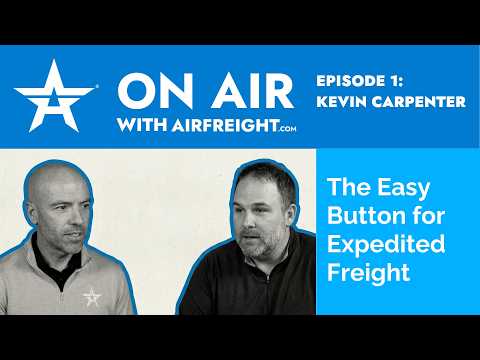
Kevin Carpenter: Welcome to On Air with Airfreight.com. I am your host, Kevin Carpenter. I am joined today by one of the top expediters here at airfreight.com. His name is John Mark Peterson. John Mark, thank you very much for joining me today. How you doing, buddy?
John Mark Peterson: Dude, I'm pumped. Thanks for having me on, neighbor.
Kevin Carpenter: You're welcome. You are absolutely welcome. Thank you for coming. We thought that this podcast could use a little southern flair, and here you are. John Mark, go ahead.
John Mark Peterson: You're Southern now. I was going to say, you're Southern now. You live in Alabama.
Kevin Carpenter: Yeah, that's true. We don't want that getting out, but yeah, that is true. John Mark joined us in 2021 at the beginning of the year. He immediately excelled as one of the top guys here in terms of freight booked, customers handled. He really has demonstrated amazing work ethic and willingness to learn. He's probably our most accomplished pupil. I'm very proud of him. John Mark, why don't you tell us what you came from prior to airfreight.com.
John Mark Peterson: Yeah, I worked at what was just kind of your run-of-the-mill truck brokerage, mainly full truckloads. There's a dime a dozen. Where I live alone, there's probably two or three dozen different offices, different brokerages. I was able to kind of bring that over here. It's a little bit of a different attitude here though than it is at some of those places. When you're in that community, you meet a lot of people, obviously, who do it, and stories get told and you kind of share experiences. And they're all kind of similar. It's kind of funny actually — when we were talking about doing this, I was thinking back to when I was over at that place. The whole attitude is kind of different at places like that than it is here. So it's kind of a funny story: the guy who owns the one I worked at really wanted it to be like a Wolf of Wall Street office. And so Friday mornings, he would pick someone out and they'd have to dress up and they'd come in, and for 15 minutes at the beginning of Friday they'd do a pump up thing. But it was all based around money. It was all based around how much money you can make. The pump ups would be like, let's go out there and get that money today, and there'd be music in the background. The owner's philosophy — he called it the boiler room. He wanted it to be like Wolf of Wall Street. You know that scene where they've got the person on speaker phone and they're making a sale and they're all making faces? That's what he wanted it to be. And that's kind of the attitude on that side of the market. It's just sell, sell, sell, sell. So it was a pretty big switch coming from there to here, you know?
Kevin Carpenter: Would you say one of the biggest differences right off the bat is volume? Is that fair to say?
John Mark Peterson: Volume — what do you mean, like different?
Kevin Carpenter: Volume of loads being booked and managed, basically.
John Mark Peterson: Yeah, yeah. I mean, your entire job is to sell. The handling of the freight after you get a sale is secondary.
Kevin Carpenter: Right. It's looking at our service more like a commodity, versus what we do at airfreight.com, which is more of a service, I would say.
John Mark Peterson: Yeah, I'd say full truckload brokerages — your average brokerage — is a cold call boiler room. Whereas here, we're providing a service. Which was good for me. I mean, if I hadn't come over here I was probably six months from jumping out of the industry. You just kind of feel gross, you know?
Kevin Carpenter: Yeah, I think that when people hear the word freight broker in general, it carries sometimes negative connotations, based on those types of places that you're talking about.
John Mark Peterson: Definitely, definitely.
Kevin Carpenter: And I've never been in that environment, but you and I have talked at length, especially when you first started, about — again, like you said, it's all about making that sale. And the big difference is you're not selling anything that nobody else is selling. You're literally offering the same trucks, the same low quality service that the other ten freight brokers in the area are offering. So it's a race to the bottom price wise, is what I'm getting at.
John Mark Peterson: And it's actually going to be interesting — they passed this bill now, or the courts came down with this ruling, about how a broker can be held liable for negligence. And I was thinking about that, and man, we're in a good spot here, because if there's one thing we're not, it's negligent. The vetting process is crazy here. And we have a pool of carriers that we work with and have worked with for 10 years or something. But I was thinking about all these guys I know who work at these other brokerages, and they've got to be terrified, because there's no vetting. If you don't mind, I'll go into what's different, maybe to pull the curtain back a little bit. So at these brokerages, they all do the same thing. They all use the same load boards. They all post on these load boards and they all have the same carriers calling. They're looking at these load boards and going, so-and-so also has this load posted, they must be talking to this customer. They see all of that. And so they're fighting to get these — I've got to be $50 above this guy. And then that guy sees you and he's like, I've got to be — and so they drive the prices up.
Kevin Carpenter: You're fighting on two fronts, right? You're fighting on the customer front, trying to be the lowest price, and then on the carrier front, you're fighting to be the broker that the carrier is willing to give their truck to. So you're fighting two fronts.
John Mark Peterson: Yes. And these carriers are playing that game too. They see it also, and so they're calling all the brokers that have posted and trying to get a little bit more money. So the carriers and the brokers all see all this — the customer doesn't. And the other thing too is, they'll just go, we just need to sell. We don't care if it's a bad carrier or whatever. And on the flip side, there's so many brokers these carriers can get loads from. They can do a bad job, they can lie, they can be dishonest, they can just not show up, and it never affects them. There's so many brokers.
Kevin Carpenter: Because there's so many other brokers that will award a shipment to them. With very little vetting, with very little due diligence.
John Mark Peterson: Exactly, and the same for brokers. There are so many carriers out there that are used on these load boards. They can be dishonest to a carrier and, so what, they never have to use them again. So that's what's interesting. That's the biggest difference I think — from having a group of guys you've cultivated over years and work with. They know us and we know them, and so that is the biggest difference. Because you've got three people in the ladder — the customer, the broker and the carrier — and there's a thousand carriers and a thousand brokers. They can be dishonest and not do a good job and it'll never affect them. There's just too many more people to choose from on either end of that. Whereas here you're held accountable a little bit more because of the group of guys. We all know each other. Word would get around if we treated carriers bad, and word would get back to us if carriers were dishonest.
Kevin Carpenter: Sure. Yeah, in fact, Todd Anderson and I did a podcast at length about the airfreight.com vetting process, and then our carrier selection on an individual load. We drilled down quite a bit on those relationships that we have formed with these carriers over the years, which is totally opposite of what's going on in what we call truckload brokerage. And I think it's interesting how you joined us at airfreight.com — because you were one of the brokers that we talked to once or twice, and we trusted you with some loads there and you did a phenomenal job, and something about you stood apart, and one thing led to another and we brought you on. So let's talk about the culture shock that you probably felt when you came over here. What would you say right off the bat, just doing the job — what are the biggest differences?
John Mark Peterson: Just like we talked about earlier, the fact that once you make a sale it's not done. A bigger focus is on doing our service and doing it well, more so than getting the sale. One thing that as a company AirFreight's done really well is cultivate the sales pipeline. So the service is more important than the sale, because we're not having to make 60 cold calls a day to go out and get these guys. And so it's like, look, we've narrowed this pipeline down to where we'll get you the work, you just have to do it well. And that kind of changes the whole dynamic of how we do our jobs.
Kevin Carpenter: Yeah. And to give our listeners some insight, our leads come from people who are looking for our service. Our leads come from the major search engines, and we're well positioned to be the top options that the customer sees whenever they're in that time critical freight situation. They see our five star Trustpilot rating. They see our well designed and well explained website that details our services. They call our number — or they can submit a quote online, but they call our number. They don't experience a phone tree where they have to hit one to do this or two to do that. The phone gets answered by a human right off the bat, which takes people off guard and immediately adds a comfort level for the customer. I'm sure you've noticed that.
John Mark Peterson: Yeah, it's funny. When we were talking earlier today and I was trying to get in touch with a customer to confirm something, we called and it was like an AI chatbot. And we were talking about how frustrating that is, because they couldn't even transfer me through to the person I wanted to speak with. I still haven't received a call back.
Kevin Carpenter: Right. You called your customer. Your customer had an AI chatbot answer, and I listened to you talk to the chatbot. It was pretty funny. You weren't very nice to her.
John Mark Peterson: Well, she wasn't very nice to me. I still hadn't got a call back.
Kevin Carpenter: Okay, so let me ask you this. In the truckload world, how much updating happens? How much does the broker keep track of the carrier as they're picking up the shipment, moving it down the road and delivering? And then, in consequence, how often does the broker update the customer?
John Mark Peterson: So that's totally different too than what we do. That's kind of a hard question to answer, because the way we do it here, if a customer calls and you answer, you're going to get the load covered with them. And then if they have any update needs or questions for you, they call you directly. You give them all the updates. It's all you. At these full truckload brokerage places — part of it's because I think they don't want brokers to steal their customers and leave, but also part of it I think is just a cost saving measure — they'll have teams. So say me and you are on a team, and then we'll have someone, say there's a guy named Matt, he's our dispatcher. So we booked a load and then we just give it to Matt and we forget about it. And then maybe we'll tell him when it's been picked up — probably not, really. His main job is to just collect the PODs after delivery. He's not watching the loads. His main job is to just keep paperwork in line. So really, nobody's updating. Maybe a couple updates, but not many. That's totally secondary.
Kevin Carpenter: How often did customers have shipments that were obviously time critical to them, obviously important to them, and they're using one of these run-of-the-mill truckload brokers?
John Mark Peterson: To be honest, it's kind of a different type, just because of the nature of how it works. A lot of times it's not as time critical stuff. Also just because I think they know you can't really do it in that position. And so occasionally you have something that's somewhat time critical — they need it picked up tomorrow and then delivered in a couple of days. And that would be considered probably somewhat time critical over there.
Kevin Carpenter: Okay. Which is a big contrast to us, because many of our customers are calling for something they need picked up yesterday. Which we can't do obviously, but we can pick it up within a couple hours.
John Mark Peterson: Right. Yeah, and it actually is interesting, especially right now when rates are going crazy due to fuel prices. You have a lot of these brokers that can't cover their loads for what they've committed to. And so we have calls from these customers who are like, I had a broker fall off on this and we need it covered. You constantly hear them go, whoa, you can pick up in three or four hours? Like they don't expect it, I don't think.
Kevin Carpenter: Yeah, it doesn't seem like they put the same premium on their word and follow through. And it's almost like it's this well understood thing — and I suppose customers are savvy about this. They know what they're going to get, but they also know that they have a budget and this shipment isn't necessarily a priority, and they just need to get this forty thousand pounds of freight moved as cheaply as possible.
John Mark Peterson: Right. Yeah, I mean, there are some outliers to that, but not really. That's 98% of it. That's kind of what it is.
Kevin Carpenter: So therefore when the broker calls them back a day later, or even two hours before it's supposed to pick up, or maybe sometimes not even at all, right? And then the truck doesn't show up when they're supposed to be there — I guess the broker doesn't take that as seriously. As an expediter, as someone that's been in the expedited freight world, and that's the only side of the freight world that I've been in, I cannot fathom dropping a load on a customer that has something set up with me.
John Mark Peterson: I can't tell you how many times, when I worked there, people would just go, oh man, this load was supposed to pick up yesterday and they never did it. And it's like, yesterday? You're 30 hours past pick up time. You're just now realizing this? It's pretty crazy, especially from here. That's insane. 30 hours late? Happens all the time.
Kevin Carpenter: Yeah. But it makes sense when you think about the volume mindset, the commodity volume mindset that these people have. So if you're a freight customer and you're listening to this, know what you're getting into with a commodity or a volume freight broker, right?
John Mark Peterson: Yeah. And look, to be fair, sometimes that's what people want. You've got like steel, for instance — big steel, where they're doing 30 truckloads a day. That's kind of what they want, just because of the amount of trucks they're shipping out. Every dollar counts when you have 30 loads a day. And so in that instance...
Kevin Carpenter: Yeah. So one truck not showing up isn't the same magnitude when there are thirty trucks that are already leaving that place. Okay, that makes sense. When you're talking about the individual guys in that truckload broker environment, I imagine it would get pretty cutthroat.
John Mark Peterson: Oh yeah, it's constant stories about so-and-so stole my customer, or these brokers and people leaving and stealing customers, and whatever else.
Kevin Carpenter: Because it is an eat-what-you-kill model, quote unquote, where you're making commission on the loads that you handle. So therefore this is your money and this is this guy's money, and you guys are trying to make as much money as you can in that setup.
John Mark Peterson: And you have different managers managing different teams who also get paid off of what their sales guys do. And so these managers will somehow try to hide stuff so that their guy makes more money, so they make more money. That's inside the company, which is interesting. So you've got a lot of guys inside the company, managers and sales guys, who are trying to back in on somebody and steal their customer. And then the manager will try to go to bat for their guy after they just stole someone's customer, because that's good for them, you know?
Kevin Carpenter: Absolutely. That's a perfect segue into — if we could just briefly talk about when you started with airfreight.com. What did you notice that was different about that? And I'll talk a little bit first. We had Steve Janssen on an earlier episode, and we talked about how far we've come as a company — not just our technology but also figuring out where we fit into this freight equation. The things that we're talking about right now, where we openly are willing to tell people, hey, you're probably not our customer. You're probably looking for a volume truckload provider. You're probably looking for a partial load. You're probably looking for something else that's not us. We are here for the most critical load, the one where if it fails there's a problem. There's a major problem. And therefore the premium that you're paying for our service is well worth it. So we didn't just know that right off the bat. We figured that out. We put together our best practices, we put together a very good technology stack and processes and all that jazz before you started with airfreight.com. So when you started, it was very much — and this is why you're special to me — because we just downloaded all of this stuff that we had learned over the years and figured out. And we downloaded that to you, and you were the perfect guy to take the mantle on that, because you came from this boiler room mentality, this boiler room setup where you were willing to just hit it hard. Because these leads that you were getting were way better than the leads that you're going to get in that environment. So here's where I'm going with this. We didn't just throw you to the wolves either. We didn't just say, hey, do your thing. We spent a lot of time — and what I'm getting at is the culture here is night and day different from a truckload broker. Can you speak to that at all?
John Mark Peterson: Yeah. Like we talked about, it's kind of eat what you kill over there. So it was very much everybody was out for themselves. And then I came over here and it was like, hop on the phone, we're selling for the first — what would you say, three or six months? — the entire day, and I'm also talking to a co-worker here and getting their feedback.
Kevin Carpenter: Sure. A billion questions. Tons of questions. But we were happy to — you showed the hunger and the willingness to learn. You're very teachable. So we were happy to be there for you. And it's paid off. It's paid off for everybody, I would say.
John Mark Peterson: Yeah, it's much more of a company mindset than a solo mindset. It's like, you or Steve — still, you ask me, hey, we're considering doing this for the company. Let's see how it affects you, how it affects our customers, how it affects the company as a whole. What do you think about that? Which is cool, because really, I'm just kind of a sales guy here and I handle the shipments. I'm kind of just the boots on the ground type of employee, you know what I mean? And so it's cool that you guys consider — how do you think this would affect you? How do you think it would affect your customers? How do you think it would affect the company? And that's totally different than where I came from.
Kevin Carpenter: Well, awesome. We appreciate you. We look forward to more success with you and as a company. So we are going to wrap this up with what I like to call the On Air Gauntlet. I'm going to hit you with three rapid fire questions. Don't think too much about it. I want you to just whip off an answer as fast as you can. Are you ready for the On Air Gauntlet, John Mark?
John Mark Peterson: I don't think so.
Kevin Carpenter: All right. Question one. What is your dream vacation?
John Mark Peterson: New Zealand.
Kevin Carpenter: What's something you've learned from freight that applies to life?
John Mark Peterson: Communication. Being able to ask questions and trying to think a solution through, instead of just going my way, you know.
Kevin Carpenter: What is your most controversial food opinion?
John Mark Peterson: Ooh, mayonnaise is horrible.
Kevin Carpenter: Wow. Okay.
John Mark Peterson: It's horrible.
Kevin Carpenter: Yeah, that's pretty controversial. John Mark, thank you very much for joining us. Thank you very much for being on air with airfreight.com.
John Mark Peterson: Yeah, thank you, man. Enjoyed it.




 25:01

 22:03
 27:18
 20:19
 20:26
 31:04
 26:48
 24:30
 24:42

 Call (800) 713-1000
Follow Us