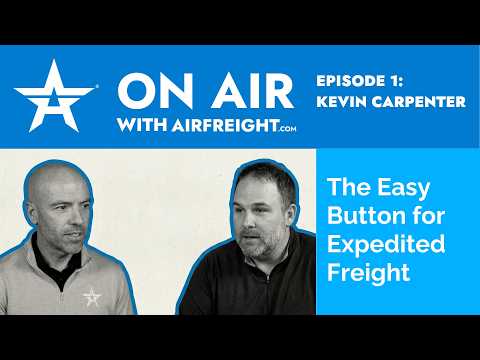
Kevin Carpenter: Hello. Welcome to On Air with Airfreight.com. I'm your host, Kevin Carpenter. Very special treat today. We have one of the original expediters with Airfreight.com, Steve Janssen. Started with AirFreight in 2011. How many expediters were here when you started?
Steve Janssen: There was just one other, really. Two of us.
Kevin Carpenter: So now here we are, fifteen years later, Steve. It's an interesting company. I work there too. And I love what we do. And I'm very excited to have you.
Steve Janssen: Yeah, it's a pleasure to be here, Kevin. Appreciate you asking me first of the group.
Kevin Carpenter: Absolutely, wouldn't have it any other way. Steve's like a brother to me. That's definitely part of what makes it great here — the other guys, and there's not many of us. Steve, let's jump right into it. You started in 2011. It was way different than it is now, right? Fair to say. What are some ways?
Steve Janssen: Yeah. I'll tell you, when we started everything was on a sheet of paper. Thinking back — everything was handwritten back then, and that wasn't that long ago. I mean, fifteen years, and now everything is just done electronically. But yeah, we had two or three desk phones, and you just juggled phones and wrote down your bills of lading and wrote down the rate agreements, and then customers would print off a credit card authorization form and pen write it and fax it back in. And we knew at that time, though — we knew the carriers personally, and we still do, but we couldn't just let twenty carriers know at the same time what jobs are available. It was one at a time, like, I know you're here, are you available? And we've advanced quite a bit.
Kevin Carpenter: Well, yeah, I mean, we've stayed on the forefront of that technology. It changed pretty quickly, I would say. I think I started about a little under a year after you, and I don't have the same experience, because we were using a network — an expedited freight network — to post loads out to. So in that short period of time the tech stack got a little better.
Steve Janssen: Changed quick, yeah.
Kevin Carpenter: And that was one of the things that struck me — that we were on the cutting edge when we started. I can remember Dan — and it's not like this now for new expediters starting, but when I started, Dan gave me an iPad 2, which was the cutting edge iPad at the time, and the iPhone 4S, brand spanking new, also the cutting edge iPhone at the time. And I couldn't have been more thrilled, because I was always a technology guy. And that was one of the commitments Dan made from the very beginning. He was like, tell me what you need to do your job, we'll do it. And if anything, we're the ones that think about the cost of things, because for Dan it's very simple. Will this make it easier? Will there be ROI? And, you know, yes or no.
Steve Janssen: Right. And it's not just easier for us, it's easier for the driver, the carrier, us, and the customer. It's easier for everybody by forward thinking through technology. And that's a good point, because we changed so much in the first year. We really did. We said, well, this is all wrong. There's got to be a better way, and we changed it quick, and we keep changing it. And that's another thing too. Going back to other companies that I've worked at — and there haven't been a whole lot of those — they just say, this is your best practice and this is it. And here, every week we talk about ways to get better. We have meetings every single week.
Kevin Carpenter: Yeah. Small and nimble, not afraid to change.
Steve Janssen: And after 15 years of fifty-two weeks, you'd think you'd run around in a circle, but we still keep looking at new ideas every week.
Kevin Carpenter: Sure. And I would say the key factors that we're looking at when we improve our tech processes are how can we make this more streamlined for the customer, and then how can we make it more streamlined for the expediter — because those are one and the same.
Steve Janssen: I've got to add, by keeping the personal touch. It's very easy to go complete automation, and then you lose track of that personal touch. And I think when you're working with anything high value or emergency, you absolutely one hundred percent need a good, confident, experienced person basically piloting that order from start to finish. It can't be automated.
Kevin Carpenter: For sure. And we'll back up a minute, just on the off chance that there's someone still listening to this podcast that doesn't know what we do. We do expedited time critical freight shipments. Our main value proposition is that someone who needs to ship something fast, and they know nothing other than this is the most important shipment I've ever done or the most important shipment of the day — it cannot fail — and then they go to the search engines to find the right company to do that. We are positioned for the customer to find us. They reach out to us, and when they call us there's no phone tree that they have to dial one or two or anything like that. They get a human immediately. And that's the crux of the value proposition, because you get a human from the very beginning of the process all the way through, which means you're not just going through a pipeline of automated emails and stuff like that. And even though we've looked at how we can add things to that effect to make the process easier, the agent is orchestrating the whole thing, like you just said, Steve.
Steve Janssen: Right. You have to keep customer experience in mind with every decision, and that's something we always do.
Kevin Carpenter: Yeah. A big part of that is our model, which is a single point of contact model. So not only are you getting a human on that first phone call, but you're getting the only human you ever need to deal with again. Let's say it's Steve that answered the call — you're going to get Steve's mobile phone right there in his email signature. He's available, and over the fifteen years of doing this, Steve's been on call for fifteen years. He's handled emergencies at dinner time, and that's the nature of the beast. That's part of what we love about it though — the stakes are high for these shipments. So Steve, just off the top of your head, how often do you have to deal with something in the evening?
Steve Janssen: Not as often as it used to be. We're not a call center so much, where you're trying to burn through fifty, eighty calls or more to get one or two jobs. When you're good at what you do and you have a customer that relies on you — and in our case now, after fifteen years, we have a few hundred customers that rely on us either a few times a week, and we've got customers that call us a few times a year. But they save our information and they know that if they call or text and I don't answer right away, I'll call or text right back. When we first started, we were a hundred percent answering everything, every opportunity throughout the evening, and now we've spread it out amongst the team as the team grows to manage those evening calls. But regular customers, I'll still answer any hour. It's just not as often as it used to be, because every time they call now, it's a legit job.
Kevin Carpenter: Exactly. From our perspective as agents, that's the important thing. These are relationships that we have with these customers. So when Sherry's calling, I know Sherry. I've helped her with a dozen of her most urgent and important shipments. And she knows I'm going to answer. It's really interesting though when, let's say you're sitting down to dinner with the family, and then one of those customers that does call once a year hits you up. Those are the ones where you're happy to talk to that person again. It's always interesting, it's always an emergency. We have a customer that calls once every one to two years and they need an air charter. Just like, I need another one of those dedicated planes — which is one of the funnest things that we do, one of the highest stakes. From a cost perspective, it's definitely the most expensive service that we offer, because it's moving freight as fast as humanly possible. That's the way I pitch it to the customer. Until we get that flux capacitor all the way developed, there is no faster way to move freight than via air charter.
Steve Janssen: And you said highest stakes, but really once it's booked, it's the lowest stakes as far as getting that freight to delivery.
Kevin Carpenter: Yeah, lowest risk, lowest chance that something's going to go wrong. Of course. It never gets old though, coordinating one of those shipments, because from the expediter's point of view, you have about twenty, give or take, phone calls to make to make sure that that freight is going to move in a continuous manner — that once it gets to the FBO at the origin airport, there's people there. If you need to load the plane with a forklift, you have to make sure that there's a forklift there. Sometimes you make a lot of phone calls just trying to find a fixed-base operator with a forklift. But yeah, many calls. I won't bore people with the details, but there's nothing more fun than pulling up your flight tracker and watching your plane fly across the country with a shipment that a customer paid us twenty five thousand dollars to get there tonight by 6 PM. It's just one of the biggest rushes ever. So if you ever need something like that, customers out there, call Steve or myself or any of the other guys here at airfreight.com. Sorry — do you want to say something else?
Steve Janssen: No, that's good. You touched on — I do want to just say, it is the safest. There's so many customers we've seen throughout the years that are given both options. The scheduled air for the next day, the charter — and they say, you know, five, six pallets, let's risk it on FedEx. And we've got great rates with FedEx because we work with FedEx daily, and we know what the probability of that happening on a large volume shipment is.
Kevin Carpenter: That's the only cargo operator that we use, by the way.
Steve Janssen: The chances of that making the final leg next day is very slim on large volume. So if you're really dealing with a potential plant down situation next day, charter will save you so much more money and headache in the long run.
Kevin Carpenter: Yeah, I mean even a ground expedite.
Steve Janssen: Yeah, it's true. Ground expedite would too, if the mileage is appropriate.
Kevin Carpenter: Yeah. I tell customers, if your freight is critical enough, you never want to hand it to someone else and hope that they do the right thing with it. It doesn't matter if it's the best cargo air freight company out there, which is FedEx, or one of the commercial airlines — we do everything in our power not to go that route, because we've seen it go sideways just too many times when someone has something critical. So anytime you're in a situation where the freight is critical, you don't want it passed to a network, especially a network that requires workers to make that network work. As we saw during the COVID times, when there was a shortage of workers everywhere — there was a shortage of people working. So these networks that are already prone to error and slow, they were even worse. And the companies know this. The companies that are selling this service know. They suspend their service guarantees. There are clues. They don't just come out and say, hey, we suck now, but there are definitely clues that they know that they have problems moving that freight. So ever since COVID times, from my consulting perspective with my customers, I'm always advising them against moving it scheduled.
Steve Janssen: Well, what COVID did was it allowed failure to be accepted. Prior to COVID there was more or less a guarantee. I mean, there are guaranteed options, but everything was for the most part guaranteed, and post COVID there is no such thing anymore. There's a reason to fail every single shipment, and to me that's not what you want to put forward as your best option.
Kevin Carpenter: Yeah. Fail is an interesting word, because I don't think a lot of transportation companies even have that word in their vocabulary anymore. Fail. Failure. Service failure. Those are words that we're using. It's not a word we like to use, but it's not a word we're afraid to use either. And from the expediter's perspective, not every shipment's on time, not every driver, not every cargo van driver takes the correct route or even does as good of a job as he should do. But when we're late, that's a service failure. And when you actually use that language with the customer, that goes further to build the relationship, because we're acknowledging that we failed. Nowadays, there is no acknowledgement of the failure. It's just automatic. If you're putting this freight in a network, it is not going to get there at the time that they tell you to — good odds anyway. Not a hundred percent, but a very good chance it's not going to make it.
Steve Janssen: And we really don't see it. I know anybody's going to say that, but we don't really see service failures too often. But we will give multiple solutions to the problem that the customer's giving us, so we can talk it out before we book any one particular avenue or one particular mode of transportation. So we have seen what is prone to more failure, like we're talking about through scheduled air right now. Ground expedite, you won't see it as often unless there's an hours issue.
Kevin Carpenter: No. I mean, we're in the high nineties percentage on time rate for a ground expedite.
Steve Janssen: You will see weather and traffic and construction certain times of year. But you just be real with your customers and let them know what's truly expected. And that goes a long, long way.
Kevin Carpenter: Yeah. When you're laying out options — let's just say it is a shipment that scheduled air freight is a real option for, because it's such a long trip and because they need it next day. Most likely it's not going to make it next day via scheduled air if it's multiple pallets. You build that in. You tell the customer this up front.
Steve Janssen: It's just not enough room. Right.
Kevin Carpenter: Well, we tell the customer this up front because the carrier's not going to tell them up front. So that's where we're more of a consultant than anything. And that's what makes it so easy to do the job, though, because we're just being honest. We're just being an impartial expert in this customer's emergency. When you say, hey, I realize going overnight air freight on paper is even cheaper than putting it on a cargo van and driving it across the country, and it says it's going to get there faster — it's most likely not going to get there faster than the van would. Just so you know, there are service issues with this. And then when it happens, it's a lot easier to have that conversation with the customer, that's for sure.
Steve Janssen: It's funny too, because we go back to our earlier conversation with automation, and I've seen firsthand automation will book that order of a multiple pallet shipment. And if you're not familiar with scheduled air — scheduled air at the airport, they have multiple capsules, but there's not very many of them, and these capsules will hold like a three to six pallet floor spot. And if a customer has certain rates with one of these airlines, they'll book through an automation platform eight, ten pallets at a rate that could be about the same price or just under a charter, a dedicated jet price, and they'll think that that's going to deliver next day. Well, you get to the airline and they've already taken the freight that's going to take up seven of those pallet spots, and they're sharing.
Kevin Carpenter: Yeah. No human involved. No honest human in the equation.
Steve Janssen: Right. And if they have another customer that's paying the same or more, they're going to do whatever's easier. The dock worker's going to take whatever's easiest to load into these containers, unless you're on the phone with them — and even if you're on the phone with them, sometimes they still take whatever's easier. And whatever's easier to them is fewer complaints. So if you have one order that's going to take up two of these capsules, and you have twenty customers that are going to take up two of these capsules — well, if they're going to piss off one customer as opposed to twenty, they're going to do that, and then that automation and what you booked, it's out the window.
Kevin Carpenter: Yeah. Business decisions are being made at a very high level that have very little to do with us. And when a company is as massive as a FedEx or a UPS or a DHL or some of these guys, those decisions are not in parallel with the customer that's actually shipping. And to circle it back, that's what we are at airfreight.com. Steve, this has been a pretty stimulating conversation. We'll have to listen to it and see how — if this was actually interesting or if it was boring for anyone out there. I will say that the next time we talk, it'll be more interesting. I can guarantee that to everybody listening, because we're only going to get better at this. But in the meantime, Steve, I want to just say thank you for being on air with airfreight.com.
Steve Janssen: You got it. Thanks for having me, Kevin.
Kevin Carpenter: Yeah, you're welcome. Look forward to having you again.




 25:01

 22:03
 24:15
 27:18
 20:19
 31:04
 26:48
 24:30
 24:42

 Call (800) 713-1000
Follow Us